Why Your Child's $60/Hour Tutor Can't Compete With What AI Does in 20 Minutes
TL;DR
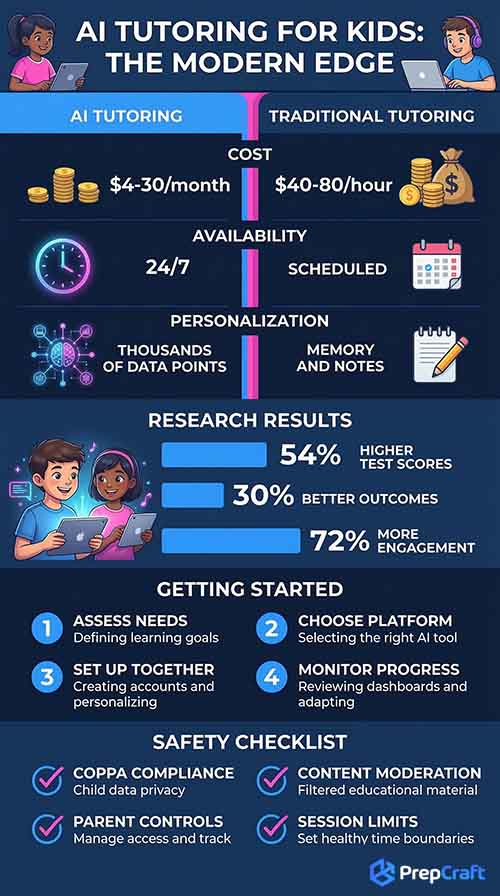
AI tutoring for kids uses adaptive algorithms to personalize learning in real time, adjusting difficulty, pacing, and explanations to match each child's needs. Research shows students using AI-powered learning achieve 54% higher test scores and 30% better learning outcomes than those using traditional methods (Engageli, 2026). Platforms cost $4 to $30 per month compared to $40 to $80 per hour for human tutors. For grades 3-8, look for COPPA-compliant platforms with adaptive difficulty, parent da
Why Your Child's $60/Hour Tutor Can't Compete With What AI Does in 20 Minutes
Table of Contents
-
Why Does Research Say AI Tutoring Outperforms Traditional Methods?
-
How Do I Get Started With AI Tutoring for My Grades 3-8 Child?
Last September, a mom named Priya watched her 10-year-old son Arjun fall further behind in math. She hired a tutor at $60 an hour, twice a week. After three months and over $1,400, his grades had barely budged. The tutor kept reviewing topics Arjun had already mastered, wasting half of every session. Then Priya tried an AI tutoring app. Within the first week, it pinpointed that Arjun's real problem was fractions, not the algebra his tutor had been drilling. Six weeks later, his math grade jumped from a C to a B+.
If that story sounds familiar, you're not alone. Millions of parents are discovering that AI tutoring for kids offers something traditional approaches simply can't: truly personalized learning that adapts to exactly what your child needs, when they need it. In simple terms, AI tutoring is software that uses artificial intelligence to act like a patient, always-available tutor who remembers everything your child has ever worked on and never has a bad day.
Whether your child is in third grade or eighth grade, this guide will walk you through how AI tutoring actually works, what the research says, how to evaluate safety, and how to choose the right platform for your family. No jargon. No hype. Just honest answers from one parent to another.
What Is AI Tutoring for Kids and How Does It Actually Work?
AI tutoring for kids is a form of personalized learning that uses artificial intelligence to create an individualized experience for each student. Unlike a pre-recorded video or a static worksheet, an AI tutor interacts with your child in real time, adjusting difficulty, pacing, and explanations based on how they respond.
How Adaptive Algorithms Track Your Child's Progress
Modern AI tutoring platforms use adaptive learning algorithms that monitor your child's performance across every question and every session. When your child answers quickly and correctly, the system moves on to harder material. When they struggle, it slows down, offers a different explanation, or breaks the concept into smaller steps. This creates what educators call a "personalized learning path." Instead of following a fixed curriculum at a fixed pace, your child works through material in the order and speed that makes sense for them.
The key takeaway: Unlike classroom instruction designed for 25 to 30 students at once, AI tutoring adjusts to your individual child, every single session.
Teaching AI vs. Answer AI: A Critical Distinction
Not all AI learning tools work the same way, and this distinction matters more than most parents realize. Teaching AI uses the Socratic method. It asks guiding questions, provides hints, and helps your child work through problems step by step. The goal is understanding, not just correct answers. Answer AI simply hands your child the solution. Tools like basic ChatGPT or Photomath can solve problems instantly, but they don't teach the underlying concepts.
A common mistake to avoid: Many parents assume all AI tools are educational. If your child is using a tool that just gives answers without explaining the reasoning, they're building dependency, not skills. When choosing an AI tutor for test prep, look for platforms that teach rather than just answer.
Why Does Research Say AI Tutoring Outperforms Traditional Methods?
Students using AI-powered learning environments achieve 54% higher test scores and show 30% better learning outcomes compared to traditional methods (Engageli, 2026). These aren't small gains. They represent a fundamental shift in how effectively children can learn when instruction is personalized.
The Data on Test Scores and Learning Outcomes
A 2025 systematic review published in Nature found that AI-driven intelligent tutoring systems in K-12 education produce generally positive effects on learning and performance. The key advantage is personalization: every child gets instruction calibrated to their current level.
The numbers get even more compelling when you look at specific studies. A randomized controlled trial published in Scientific Reports found that AI tutoring outperformed in-class active learning with an effect size between 0.73 and 1.3 standard deviations. To put that in perspective, an effect size of 0.8 is considered large in educational research. Even more striking, the AI tutoring group achieved these results in less time: 49 minutes compared to 60 minutes for traditional learners.
Engagement That Actually Sticks
One of the biggest challenges parents face is keeping kids motivated to study. According to research compiled by Engageli (2026), 72% of students report being more engaged with AI tutors than traditional study methods. AI tutors can also lower dropout rates by 20% by keeping students engaged with real-time feedback and targeted practice.
This engagement factor is huge. A child who actually enjoys their study sessions will stick with them longer and learn more over time. If your child has ever dragged their feet through homework or zoned out during a tutoring session, you know exactly what I mean. This connects directly to why smart kids sometimes hate school, and it's often about pacing and relevance, not ability.
In summary: The research consistently shows that AI tutoring for kids produces better outcomes in less time, largely because it eliminates the wasted minutes spent on material a child has already mastered.
When You Still Need a Human Tutor
AI tutoring works best as a supplement, not a complete replacement. Consider a human tutor when your child needs emotional support and mentorship during a difficult academic period, specialized preparation for high-stakes exams, accountability that comes from a scheduled appointment with a real person, or complex problem-solving in advanced subjects.
The Brookings Institution notes that AI tutoring works best when combined with human oversight, not as a standalone solution. The most important factor is matching the right tool to the right situation, and for daily practice and reinforcement, AI tutoring for kids is remarkably effective.
What Should Parents Look for in an AI Tutoring Platform?
The single best action you can take is choosing a platform that genuinely adapts to your child rather than serving the same content to every student. Here's what separates the great platforms from the mediocre ones.
Adaptive Difficulty and Real Personalization
The platform should adjust in real time based on your child's responses. Does it get harder when your child is doing well? Does it slow down and re-explain when they're struggling? If the app just serves the same questions to every student, it's not truly adaptive. This is where mastery-based learning becomes essential: your child should master each concept before moving on, not just check boxes.
Progress Tracking for Parents
You shouldn't have to quiz your child to know how they're doing. The best platforms offer a parent dashboard where you can see exactly which subjects your child is working on, where they're improving, and where they still need help. This turns "How was studying?" from a vague conversation into a data-informed one. PrepCraft's parent dashboard, for example, gives you real-time visibility into your child's learning progress, from subject-level performance to individual session analytics. See how PrepCraft's tracking works.
Engagement Features That Actually Work
Look for platforms that keep kids coming back through educational games that reinforce academic skills, achievement systems with badges and rewards, learning streaks that encourage daily consistency, and interactive explanations that make learning feel conversational. Marcus, a father of three in Austin, tried four different AI tutoring apps before finding one that stuck. "The first three felt like digital worksheets," he said. "My kids used them for a week and got bored. The one that worked had games, streaks, and a chat feature that made learning feel like a conversation, not a chore. My daughter has been on a 45-day learning streak and she's actually asking to do her practice sessions."
Age-Appropriate Content for Grades 4-8
Don't make the error of choosing a one-size-fits-all platform. Different ages need different approaches:
-
Grades 3-4 (ages 8-10): Short sessions of 15 to 20 minutes, visual interfaces, text-to-speech support, and reading comprehension tools with grade-appropriate content
-
Grades 5-6 (ages 10-12): Subject-specific practice in math and language arts, exam preparation features, and growing independence in choosing what to study
-
Grades 7-8 (ages 12-14): More structured learning, active recall study strategies, smart study recommendations, and progress tracking they can view themselves
Key takeaway: The best AI tutoring platform for your child is one they'll actually use consistently. Prioritize engagement and age-appropriate design alongside academic rigor.
Is AI Tutoring Safe for My Child?
Yes, AI tutoring can be safe for kids when you choose the right platform. But safety concerns are valid and worth taking seriously. Here's what you need to know.
Data Privacy and COPPA Compliance
The Children's Online Privacy Protection Act (COPPA) requires platforms serving children under 13 to obtain parental consent before collecting personal information. Any reputable AI tutoring platform should be fully COPPA-compliant. Before signing up, check the platform's privacy policy for clear language about how your child's data is stored, used, and protected. If the policy is vague or hard to find, that's a red flag.
Content Moderation and Screen Time Balance
AI tutoring platforms that use large language models need robust content moderation. The AI should never expose your child to inappropriate content, and the best platforms have multiple layers of filtering. Look for platforms built for kids from the ground up rather than general-purpose AI tools adapted for younger users.
AI tutoring is screen time, and that's a legitimate concern. The key is quality over quantity. Twenty minutes of focused, adaptive practice is more valuable than an hour of passive video watching. Many platforms let you set session time limits so you stay in control. If your child deals with test anxiety, shorter, low-pressure sessions can actually help build confidence gradually.
In summary: Choose COPPA-compliant platforms with content moderation, parent controls, and session time limits. AI tutoring is safest when parents stay involved and set clear boundaries.
How Do I Get Started With AI Tutoring for My Grades 3-8 Child?
Ready to try AI tutoring for kids? Here's a simple, four-step plan that takes the guesswork out of it.
Step 1: Assess your child's needs. Before choosing a platform, identify what your child actually needs help with. Are they struggling with a specific subject? Do they need CogAT practice or Iowa Assessments preparation? Are they looking for enrichment beyond what school offers? Knowing this helps you pick the right tool. If you're unsure where your child stands, understanding stanine scores can help you interpret their current performance.
Step 2: Choose the right platform. Evaluate platforms on adaptive personalization, COPPA compliance, parent dashboards, engagement features, age-appropriate content, and multi-child support. PrepCraft, for instance, offers CogAT and Iowa Assessments practice with AI-powered explanations that help grades 3-8 students understand every mistake, not just memorize answers.
Step 3: Set up together. Sit down with your child for the first session. Help them create their profile, explore the features together, and set expectations for how often they'll use it. Making it a shared experience builds buy-in. Kids who feel ownership over their learning tools use them more consistently.
Step 4: Monitor and adjust. Check the parent dashboard weekly for the first month. See what your child is working on, where they're improving, and whether they're actually using the platform consistently. Adjust session lengths or subjects based on what you see.
Bottom line: Start small. Even 15 to 20 minutes of daily AI tutoring practice can produce meaningful results within four to six weeks. The goal isn't to replace everything else in your child's learning life. It's to fill the gaps that classroom instruction and homework can't reach.
Frequently Asked Questions
What age is best to start AI tutoring for kids?
Most AI tutoring platforms work well for children ages 7 and up (around second or third grade). At this age, kids have enough reading ability and attention span to engage with adaptive learning tools. For younger children, look for platforms with text-to-speech support and game-based learning. The sweet spot for AI tutoring for kids tends to be grades 3 through 8, when children are developing independence but still benefit from guided practice.
How much does AI tutoring cost compared to a human tutor?
AI tutoring platforms typically cost between $4 and $30 per month, while traditional human tutoring runs $40 to $80 per hour (Engageli, 2026). For a family spending $500 per month on twice-weekly tutoring sessions, switching to an AI platform could save over $5,000 per year. Many platforms also support multiple children under one subscription.
Will AI tutoring replace my child's teacher?
No, and it shouldn't. AI tutoring works best as a supplement to classroom instruction, not a replacement. The Brookings Institution emphasizes that AI tutoring produces the strongest results when combined with human oversight. Think of it as extra practice and reinforcement that helps your child get more out of what they're already learning at school.
Is my child's data safe on AI tutoring platforms?
It depends on the platform. Always choose COPPA-compliant platforms that clearly explain how they store, use, and protect your child's data. Look for encrypted data storage, no data selling to third parties, content moderation on AI responses, and parent controls. If a platform's privacy policy is vague or buried, consider that a warning sign.
How long before I see results from AI tutoring?
Most families notice improvements within four to eight weeks of consistent daily practice. Research shows that students using AI-powered learning achieve 54% higher test scores (Engageli, 2026), but consistency matters more than session length. A child who practices 20 minutes daily will typically outperform one who crams for two hours on weekends.
Can AI tutoring help with standardized test prep for grades 3-8?
Absolutely. AI tutoring for kids is especially effective for standardized test preparation because it identifies specific skill gaps and targets them directly. Platforms like PrepCraft offer CogAT practice exams and Iowa Assessments practice with adaptive difficulty and step-by-step explanations. If your child has been identified for gifted programs, AI tutoring can help them prepare efficiently.
The Bottom Line
AI tutoring for kids isn't a future possibility. It's here, it's research-backed, and it's working for millions of families right now. Here's what to remember:
-
It works. Studies show 54% higher test scores and 30% better learning outcomes with AI-powered learning (Engageli, 2026).
-
It's affordable. AI tutoring costs a fraction of traditional tutoring, especially for families with multiple children.
-
Safety matters. Choose COPPA-compliant platforms with content moderation and parent controls.
-
Age matters. Match the platform's features to your child's developmental stage, especially for grades 3-8.
-
It supplements, not replaces. The best results come from combining AI tutoring with human support.
Your child deserves learning that meets them where they are. Not where a curriculum says they should be, and not at a pace set by a classroom of 30 other students. AI tutoring makes that kind of personalized attention accessible to every family. The question isn't whether AI tutoring works for kids. The question is which platform will work best for yours.
Start your free PrepCraft trial today and help your child master grades 4-8 test prep → PrepCraft
References
Brookings Institution (2025). What the research shows about generative AI in tutoring. Available at: https://www.brookings.edu/articles/what-the-research-shows-about-generative-ai-in-tutoring/ (Accessed: 13 March 2026).
Engageli (2026). AI in education statistics. Available at: https://www.engageli.com/blog/ai-in-education-statistics (Accessed: 13 March 2026).
Federal Trade Commission (n.d.). Children's Online Privacy Protection Rule (COPPA). Available at: https://www.ftc.gov/legal-library/browse/rules/childrens-online-privacy-protection-rule-coppa (Accessed: 13 March 2026).
Nature (2025). 'AI-driven intelligent tutoring systems in K-12 education: A systematic review', Nature: npj Science of Learning, 10(1). Available at: https://www.nature.com/articles/s41539-025-00320-7 (Accessed: 13 March 2026).
Nature (2025). 'AI tutoring outperforms active learning: A randomized controlled trial', Scientific Reports, 15. Available at: https://www.nature.com/articles/s41598-025-97652-6 (Accessed: 13 March 2026).