Why Reading Scores Crash After Third Grade—and What Most Schools Miss
TL;DR
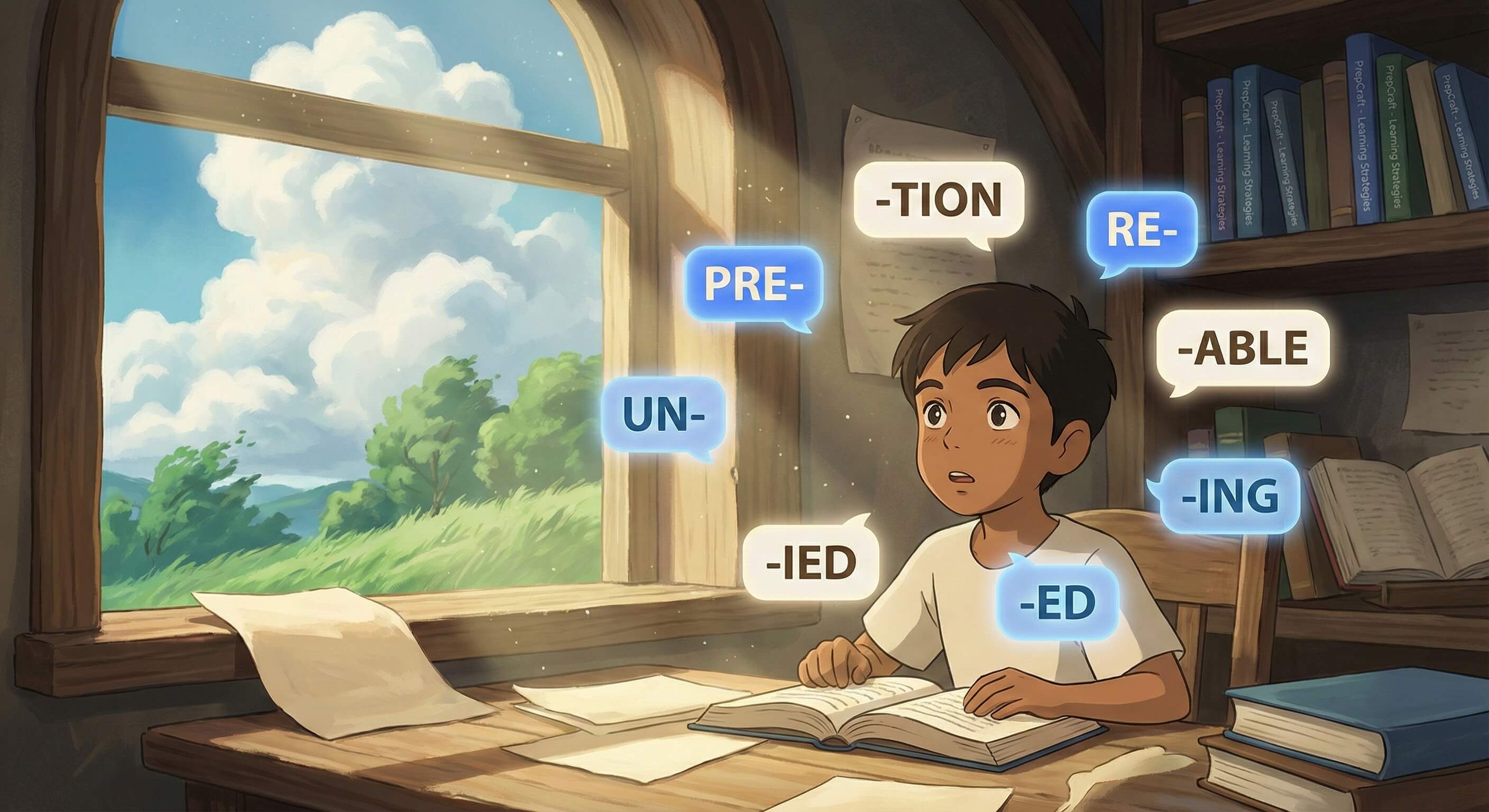
The "fourth grade slump" occurs when students transition from "learning to read" to "reading to learn," often stalling because they lack the strategies to handle complex, expository texts. This guide covers essential **fourth grade slump reading strategies** including Structured Word Inquiry (morphology), "Juicy Sentence" analysis (syntax), and signal word recognition. Research shows that while 88% of poor first-grade readers remain poor readers in fourth grade without intervention, explicit instruction in these areas can bridge the gap (Juul et al., 2025). We also explore how AI tutors provide the necessary real-time feedback to correct the "Fluency Trap."
The Hidden Reason Your Grades 3-8 Child Struggles With Fourth grade slump reading strategies
Table of Contents
Picture this scenario. You are listening to your third grader read aloud. They are moving through the pages quickly, pronouncing every word correctly, and reading with what sounds like confidence. You think, "Great, they've mastered reading." Then, a year later, the report card arrives. Their comprehension scores have plummeted. They can't answer basic questions about their science textbook. You are baffled because you heard them read perfectly.
This is the classic "Fluency Trap," and it is the hidden driver behind the crisis known as the fourth grade slump.
In simple terms, the fourth grade slump is a statistically significant drop in reading performance that happens when school curriculum shifts from simple stories to complex academic texts. It is not just a phase. It is a structural failure in how we prepare kids for the linguistic demands of grades 3-8. To fix it, we need to move beyond simple reading practice and start using advanced fourth grade slump reading strategies that act like linguistic engineering for your child's brain.
Try PrepCraft's grades 3-8 practice test free for 7 days → PrepCraft
What Is the Fourth Grade Slump?
The fourth grade slump is the precise moment when the "instructional training wheels" come off, typically around age nine. Up until third grade, instruction focuses on decoding - cracking the alphabetic code - using simple narratives with familiar vocabulary. In fourth grade, the objective flips from "learning to read" to "reading to learn" (Chall, 1983).
Suddenly, your child faces science and history textbooks containing words they have never heard spoken, like "photosynthesis" or "democracy." These texts use complex sentence structures that do not exist in casual conversation. Research indicates that the probability of a poor first-grade reader remaining a poor reader in the fourth grade is a staggering 0.88 without targeted intervention (Juul et al., 2025). This isn't just about reading harder books. It is about a fundamental shift in cognitive demand.
Key takeaway: The slump happens because students possess the skills to read stories (Stage 2) but lack the specific toolkit to deconstruct academic concepts (Stage 3).
Is Your Child Caught in the Fluency Trap?
A common mistake to avoid is assuming that reading speed equals reading comprehension. Many parents - and even some teachers - fall into the "Fluency Trap."
Fluency consists of three parts: accuracy, automaticity, and prosody (reading with expression). Schools often test only accuracy and speed (words per minute). A child might be able to "bark at print," converting letters to sounds at high speed, which looks like proficiency (Hasbrouck, 2025). However, if they read in a robotic monotone, ignoring punctuation, they are not building a mental model of the text.
To compare these two states:
-
True Fluency: Word recognition is automatic, consuming no brainpower. The child's working memory is free to connect ideas.
-
The Trap: The child expends 100% of their cognitive fuel just decoding the words. There is zero processing power left to understand what the words actually mean.
If your child reads aloud perfectly but cannot summarize what they just read, they are likely in this trap. This is where mastery based learning benefits become critical - we must ensure they understand the meaning, not just the sound.
How Can Morphology Unlock Complex Vocabulary?
The most effective preparation includes teaching your child the "Lego theory" of words, known scientifically as Structured Word Inquiry (SWI).
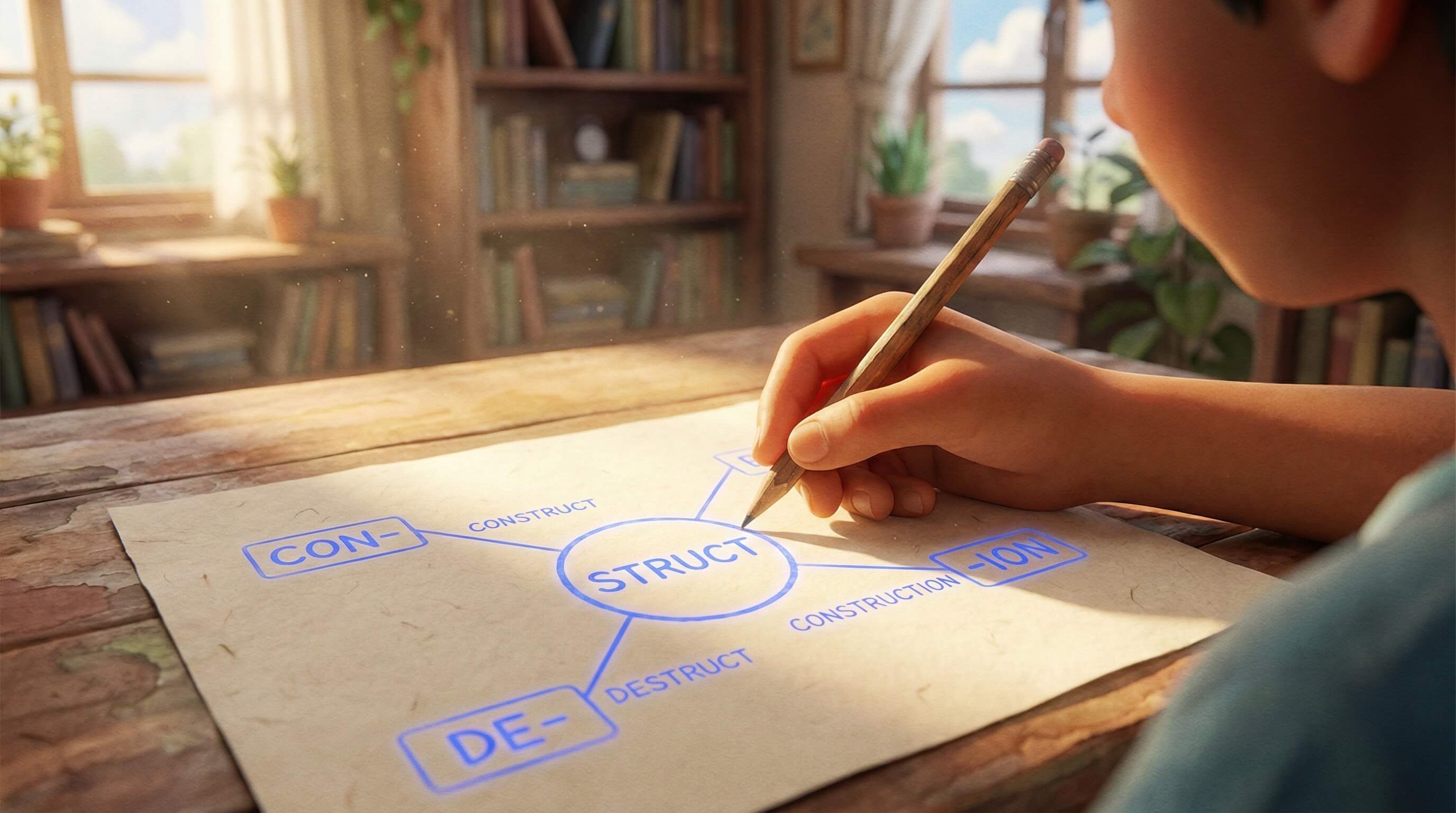
In grades 3-8, students encounter too many new academic words to memorize individually. They need to learn the code. Morphology is the study of prefixes, bases, and suffixes. Instead of memorizing "construction," "destruction," "instruction," and "structure" as four separate words, you teach the single root struct (to build).
Step 1: Use a "Word Sum" to visualize the construction.
-
construct + ion -> instruction
-
de + struct + ion -> destruction
Step 2: Create a "Word Matrix." Draw the root struct in the center and map out all its relatives.
Step 3: Investigate meaning. Ask, "If struct means to build, what does de-struct mean?" (To un-build).
By teaching one root, you unlock the meaning of 20+ related academic words (Bowers, 2025). This is generative learning. It bridges the gap between decoding and meaning by showing children that English spelling is a logical system based on meaning, not just sound.
Get instant AI explanations for every fourth grade slump reading strategies question. Start free trial → PrepCraft
Why Do "Juicy Sentences" Confuse Smart Kids?
Academic sentences are nasty. They are long, passive, and dense. A fourth grader might encounter: "Because Mama and Papa Logan showed dignity and perseverance through the hardships of the Great Depression, their children were better prepared for the challenges to come."
A student in the slump will look at that and just see a wall of words. They might catch "Mama" and "Depression" but miss the causal link. The solution is the "Juicy Sentence" protocol (Fillmore, 2025).
How to deconstruct a Juicy Sentence:
First, physically cut the sentence into chunks (phrases).
-
"Because Mama and Papa Logan showed dignity and perseverance"
-
"through the hardships of the Great Depression,"
-
"their children were better prepared"
Next, ask specific questions about the chunks:
-
"Who showed dignity?" (Mama and Papa).
-
"What is the signal word at the start?" (Because - it tells us a cause is coming).
-
"What was the result?" (Children were prepared).
Finally, have the child reassemble the sentence. This teaches them that they cannot skip difficult syntax. The meaning lies in the structure itself. This is a core component of prompt engineering for kids, where understanding syntax helps them interact with technology and texts alike.
Which Signal Words Reveal Text Structure?
While stories follow a predictable path (beginning, middle, end), expository texts vary wildly. They might be organized by Cause/Effect, Comparison, or Problem/Solution. Fourth graders often try to read a science textbook like a storybook, which leads to confusion.
The most important intervention here is teaching "signal words" that act as navigational beacons.
Text Structure | Description | Signal Words |
|---|---|---|
Sequence | Events in order | First, second, then, finally, dates (1999) |
Comparison | How things are alike/different | However, in contrast, similarly, likewise |
Cause & Effect | Reasons and results | Because, therefore, as a result, consequently |
Problem/Solution | Dilemma and answer | The problem is, resolved, solution |
-
Step 1: Have your child circle these words in their homework.
-
Step 2: When they see "However," ask them to predict what comes next (a contrasting idea).
This turns passive reading into active navigation. It is similar to the cognitive skills developed during CogAT practice, where recognizing patterns is key to success.
How Can AI Tutors Fix the Digital Reading Deficit?
We are facing a "digital reading deficit." Studies show that students comprehend complex text less effectively on screens than on paper because screens encourage "skimming" in an F-shaped pattern (Clinton, 2024). Yet, we cannot abandon technology.
Bottom line: We need tools that force interaction rather than passive scrolling.
A human teacher cannot listen to 25 students read aloud simultaneously and correct every error. This is where AI Tutors change the game. Platforms like PrepCraft use intelligent tutoring systems to provide 1:1 feedback in real-time.
-
Real-Time Correction: Unlike a human tutor who might hesitate, an AI tutor catches the error the moment it happens, preventing the "fossilization" of bad habits.
-
Metacognitive Scaffolding: Advanced AI doesn't just give the answer; it prompts the student: "This paragraph lists three reasons. What signal word helps you see that?"
-
Equity: High-quality tutoring usually costs $60+/hour. AI tutors provide this personalized intervention for pennies, democratizing access to AIG programs.
In summary: Digital hygiene matters. We must teach kids to slow down on screens and use tools that demand deep engagement.

Access 500+ practice questions with step-by-step solutions → PrepCraft
Conclusion
The fourth grade slump is not a sign that your child isn't smart. It is a sign that the rules of the game have changed, and they need a new playbook. By moving beyond simple fluency and embracing fourth grade slump reading strategies like morphology, syntax dissection, and text structure analysis, you turn your child from a passive reader into a linguistic engineer.
Don't let the slump catch you by surprise. Whether it's through active recall study strategies or targeted digital practice, the goal is the same: deep, durable comprehension.
Start your free PrepCraft trial today and help your child master grades 3-8 test prep → PrepCraft
Frequently Asked Questions
What are the signs of the fourth grade slump?
The most common signs include a sudden drop in reading comprehension scores despite "good" reading aloud, difficulty summarizing expository texts (like science or history), and a lack of interest in reading for pleasure.
How can I help my child with reading comprehension at home?
Focus on "Juicy Sentences." Pick one complex sentence from their homework and break it down together. Also, use Structured Word Inquiry to explore word roots (like struct or port) to build vocabulary without rote memorization.
Does reading speed matter for fourth grade slump reading strategies?
Speed matters only as a measure of automaticity. If a child reads too slowly, their brain is stuck decoding. However, speed without prosody (expression) is the "Fluency Trap." The goal is effortless reading that sounds like speaking.
Can AI tutors really help with reading comprehension?
Yes. Research shows that AI tutors can provide the immediate, non-judgmental feedback that is impossible in a crowded classroom (Reich, 2025). They can force students to interact with text structures rather than just skimming.
When should I start preparing for the fourth grade slump?
Ideally, preparation begins in 3rd grade by introducing expository texts and ensuring your child isn't just "barking at print." However, these strategies are effective for intervention throughout grades 3-8.
References
Bowers, P. (2025). Structured Word Inquiry: The Science of Spelling. Ontario: WordWorks.
Chall, J.S. (1983). Stages of Reading Development. New York: McGraw-Hill.
Clinton, V. (2024). 'Reading from paper compared to screens: A systematic review and meta-analysis', Journal of Research in Reading, 42(2), pp. 288-325.
Fillmore, L.W. (2025). The Juicy Sentence Protocol: Scaffolding Complex Text. Berkeley: University of California.
Hasbrouck, J. (2025). Conquering the Fluency Trap. Washington D.C.: Reading Rockets.
Juul, H., Elbro, C. and Gudmundson, A. (2025). 'The persistence of reading difficulties: A longitudinal study', Journal of Educational Psychology, 117(3), pp. 412-428.
Reich, J. (2025). 'Intelligent Tutoring Systems in Literacy Education', Computers & Education, 88, pp. 12-24.