Mastery based learning benefits | Free Grades 3-8 Guide 2025
TL;DR
Mastery based learning benefits students in grades 3-8 by ensuring they understand 100% of a concept before moving to the next level, effectively fixing the "Swiss Cheese" effect of learning gaps. Unlike traditional schools that move students forward based on time (even with a "B" or 80% average), mastery learning uses AI to identify and fill specific foundational holes. Research shows that students using mastery techniques can learn up to 10x faster and achieve scores in the 90th percentile reg
Complete Mastery-Based Learning Benefits Guide for Grades 3-8 [2025]
Table of Contents
-
Why Is mastery-based Learning Better Than Time-Based Learning?
-
What Are the Specific mastery-based Learning Benefits for Test Prep?
TL;DR: Mastery-based learning benefits students in grades 3-8 by ensuring they understand 100% of a concept before moving to the next level, effectively fixing the "Swiss Cheese" effect of learning gaps. Unlike traditional schools that move students forward based on time (even with a "B" or 80% average), mastery learning uses AI to identify and fill specific foundational holes. Research shows that students using mastery techniques can learn up to 10x faster and achieve scores in the 90th percentile regardless of starting ability. To implement this, parents should focus on consistent, short daily practice (15-20 minutes) using adaptive tools that prioritize prerequisite skills over cramming current grade-level homework.
Your eighth grader is failing chemistry. You hire tutors, you nag about homework, and you stress over late-night study sessions. But the problem isn't chemistry. The problem is that they never truly mastered fractions in third grade. This is the reality for millions of students, and understanding the benefits of mastery-based learning is the key to fixing it.
In simple terms, most schools operate on a time-based system where students move to the next unit because the calendar says so, not because they are ready. If a child gets an 80% on a test, we call it a "B" and celebrate. But that means they have 20% "holes" in their knowledge. Over time, these holes compound until the student hits a wall.
This guide will show you how to move from a "Swiss Cheese" education to a solid foundation. We will explore how modern AI tools can give your child the same elite, personalized learning advantages used by top-tier experimental schools, all from your kitchen table in just 15 minutes a day.
What Is the "Swiss Cheese" Effect in Education?
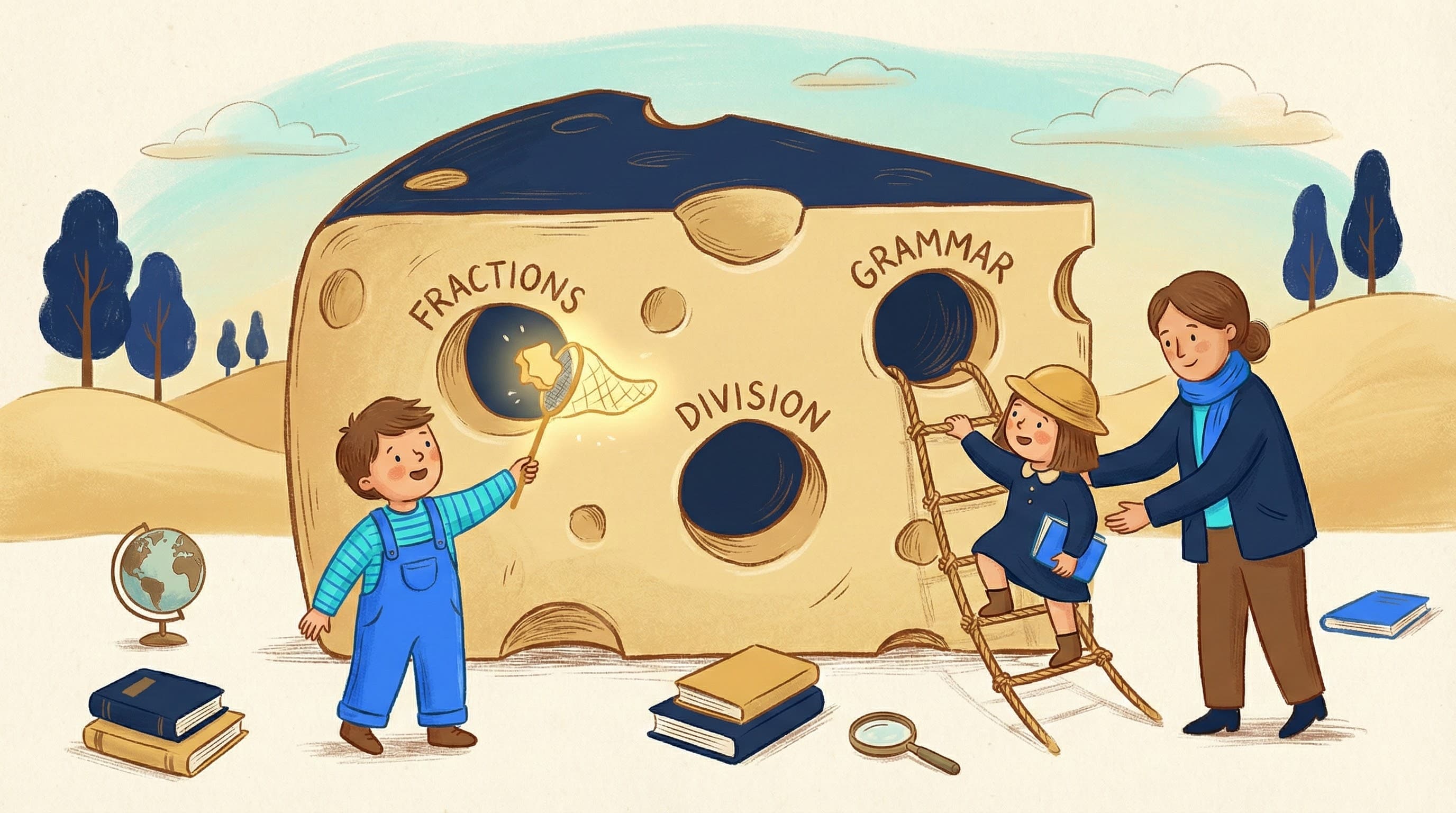
The "Swiss Cheese" effect occurs when students advance through grades while retaining gaps in their foundational knowledge, eventually causing a collapse in academic performance. It explains why "good students" suddenly struggle in middle school.
When a student scores 80% on a math test in 3rd grade, they move to 4th grade. They scored a "B," which seems fine. However, they are carrying a 20% deficit in that subject. As they progress to grades 5, 6, and 7, these deficits - or holes - accumulate.
The definition of the Swiss Cheese effect is the compounding of these small learning gaps over time.
The Compound Interest of Learning Gaps
Think of knowledge as hierarchical. You cannot do algebra if you cannot handle fractions. You cannot do chemistry if you cannot handle algebra.
-
Grade 3: Student misses the concept of number grouping (80% mastery).
-
Grade 5: Student struggles with division because grouping is shaky (75% mastery).
-
Grade 8: Student fails algebra because they are using all their mental energy trying to remember division rules rather than solving for X.
Educational innovator Joe Lonsdale explains that "A student fails high school chemistry not because chemistry is hard, but because they never mastered fractions in 3rd grade" (Lonsdale, 2024). The gaps are often years old, hiding beneath the surface of decent grades.
Why Is Mastery-Based Learning Better Than Time-Based Learning?
Mastery-based learning is better than time-based learning because it prioritizes competence over the calendar, ensuring students have a solid foundation before tackling complex topics. In a mastery system, a student does not move on to "Unit 2" until they have scored 90% or higher on "Unit 1."
The main difference between the two systems is the variable. In a traditional school, time is fixed (you have two weeks for this chapter) and learning is variable (some kids get As, some get Cs). In mastery learning, learning is fixed (everyone gets an A/Mastery), and time is variable (some kids take 2 days, others 2 weeks).
The Sports Analogy
Parents understand this intuitively in sports. If a basketball coach sees a child drop the ball 20% of the time they try to dribble, the coach does not say, "Okay, let's move on to slam dunks." The coach says, "Go back to basics. Practice dribbling until you don't drop it."
Academics should work the same way. "If you get an 80% (B average), you are moving forward with 20% 'holes' in your knowledge" (Lonsdale, 2024). Mastery learning stops the conveyor belt to fix the dribbling (or the fractions) first.
Key takeaway: Mastery learning shifts the focus from "When did you learn it?" to "Did you actually learn it?"
How Can AI Help My Child Master Grades 3-8 Concepts?
AI helps your child master concepts by acting as a personalized tutor that instantly identifies learning gaps and adapts lessons to fill them, condensing hours of study into minutes of targeted practice.
To put it simply, AI is the "light microscope" of education (Lonsdale, 2024). Before microscopes, doctors couldn't see germs. Before AI, teachers couldn't see exactly why a student missed a question. Was it a calculation error? A reading comprehension issue? A gap from three years ago? AI sees it instantly.
The Efficiency of AI Tutoring
Research shows that personalized tutoring can help students perform two standard deviations better than students in a conventional classroom - a phenomenon known as "Bloom's 2 Sigma Problem" (Bloom, 1984). AI democratizes this.
The most effective preparation includes:
Step 1: The AI diagnostic finds the specific "Swiss Cheese" holes (e.g., "needs work on 4th-grade geometry").
Step 2: The system serves specific practice questions to fill those holes.
Step 3: The student receives instant feedback that corrects errors in real time.
Step 4: The AI verifies mastery (consistency over time) before introducing harder topics.
This efficiency is massive. "The Alpha school model proves kids can learn 10x faster with AI, condensing 6 hours of schooling into 2 hours" (Lonsdale, 2024).
Get instant AI explanations for every mastery-based learning benefits question. Start free trial →
What Are the Specific mastery-based Learning Benefits for Test Prep?
The specific benefits of mastery learning for test prep include reduced anxiety, higher scores through gap-filling, and a shift from memorization to genuine understanding. This is particularly crucial for CogAT and Iowa Assessments in grades 3-8.
Closing the Gap vs. Teaching the Test
Many parents try to "teach to the test" by having kids memorize question patterns. This fails because standardized tests like the CogAT measure reasoning, not memorization.
The most important factor is foundational confidence. When a student uses a tool like PrepCraft, they aren't just taking practice tests; they are using AI to find the underlying weak spots.
-
Confidence: Students walk into the exam knowing they have "filled the holes."
-
Reduced Cognitive Load: When basic facts (like multiplication tables) are mastered to fluency, the brain frees up "working memory slots" to handle complex reasoning problems (Lonsdale, 2024).
-
Higher Ceilings: Mastery removes the artificial ceiling on a child's potential. "It's a decision, not an inherent capability" (Lonsdale, 2024). Any student can improve significantly if they put in the reps to close the gaps.

Comparison: Traditional Tutoring vs. AI Mastery Learning
To compare these two options, consider the efficiency and depth of analysis provided by AI versus a human tutor constrained by time.
| Feature | Traditional Tutoring | AI Mastery Learning (PrepCraft) |
| :--------------------- | :-------------------------------- | :----------------------------------------------- |
| Gap Identification | Relies on tutor intuition/tests | Instant, data-driven analysis of years of gaps |
| Feedback Loop | Delayed (next session) | Immediate (after every question) |
| Pacing | Fixed (1 hour/week) | Adaptive (15 mins/day, always at student's pace) |
| Cost | $50-$150/hour | Fraction of the cost for unlimited access |
| Focus | Often helps with current homework | Fixes root causes and prerequisite skills |
How Do I Implement Mastery Learning at Home?
Bottom line: You don't need to homeschool or pay $40,000 for private school to get mastery-based learning benefits. You need a routine and the right tool.
Step 1: Shift the Mindset.
Stop looking at grades as the final metric. Look for understanding. Tell your child, "We aren't moving on until this is easy for you."
Step 2: Use High Standards, High Support.
Be the parent who provides the support (love, encouragement), and let the AI be the "bad guy" that upholds the standards. "Let the AI be the enforcer of standards (grading, checking mastery), allowing the parent to provide the support" (Lonsdale, 2024).
Step 3: Consistent Micro-Dosing.
You don't need 3-hour study marathons. You need 15-20 minutes of high-intensity, personalized practice daily. This is where targeted practice makes the difference. PrepCraft's CogAT simulations help third and eighth graders experience the actual test format and timing, while AI-powered explanations ensure they understand every mistake - not just memorize answers.
A common mistake to avoid is prioritizing current homework over filling gaps. If your child is struggling with 6th-grade math homework, spending two hours fighting over it is less effective than spending 20 minutes fixing the 4th-grade gap that is causing the struggle.
Frequently Asked Questions
How long does it take to see mastery-based learning benefits?
Most parents see a shift in confidence within 2-3 weeks of consistent practice. Because AI targets the specific gaps holding a student back, academic progress often accelerates rapidly. As noted in educational research, students can cover extraordinary amounts of material - sometimes entire grade levels - in 20-30 hours of focused mastery work (Lonsdale, 2024).
Is mastery learning only for struggling students?
No. Mastery learning is equally powerful for gifted students. In a traditional classroom, a gifted student waits for the rest of the class to catch up. In a mastery system, they can soar ahead without limits, reaching their true potential rather than an artificial grade-level ceiling.
Can AI really replace a human tutor?
For identifying gaps and building fluency, AI is often superior because it is patient, data-driven, and available 24/7. It acts as a "force multiplier" for parents. However, the parent's role shifts from "teacher" to "coach" - providing the motivation and emotional support while the AI handles the technical instruction.
My child hates studying. How does this help?
Mastery learning is motivating because it gives students "time back." Instead of 6 hours of inefficient schooling, they can achieve more in 20 minutes of focused work. Furthermore, success is addictive. When a student finally understands a concept that has confused them for years, their internal motivation skyrockets.
Does PrepCraft cover all subjects for grades 3-8?
PrepCraft focuses on the critical reasoning skills (Verbal, Quantitative, Nonverbal) found in CogAT and the subject mastery (Math, Reading, Language) found in Iowa Assessments. These are the core cognitive engines that drive success in all other subjects.
Conclusion
The "Swiss Cheese" effect doesn't have to define your child's education. By shifting your focus to mastery-based learning benefits, you can help your child close the gaps that traditional schooling leaves behind. You don't need to be a math genius or a wealthy philanthropist to give your child this advantage. You just need the right approach.
In summary, stop guessing where the holes are. Use AI to find them, fill them, and watch your child's confidence - and test scores - soar.
Start your free PrepCraft trial today and help your child master grades 3-8 test prep → PrepCraft
References
Bloom, B. (1984). The 2 Sigma Problem: The Search for Methods of Group Instruction as Effective as One-to-One Tutoring. Educational Researcher, 13(6), 4-16. Retrieved from https://web.mit.edu/5.95/readings/bloom-two-sigma.pdf
Khan Academy. (n.d.). Mastery Learning. Khan Academy. Retrieved from https://www.khanacademy.org/
Lonsdale, J. (2024). Interview with Peter Attia. The Drive Podcast.
National Association for Gifted Children. (n.d.). Home Page. National Association for Gifted Children. Retrieved from https://www.nagc.org/