Complete Benefits of Mastery Based Learning Guide for Grades 3-8
TL;DR
The benefits of mastery based learning focus on ensuring a student fully understands a concept (90-95% proficiency) before moving to the next one, unlike traditional schools that advance students based on time. This approach prevents the "Swiss cheese" effect where small knowledge gaps compound over years, causing students to hit a wall in subjects like chemistry or algebra. By using AI-driven tools, students in grades 3-8 can identify and fix these specific gaps 10x faster than in a classroom setting. Data shows that personalized mastery practice for just 15-20 minutes a day can raise a student's performance to the 90th percentile.
Complete Benefits of Mastery-Based Learning Guide for Grades 3-8 [2025]
Table of Contents
TL;DR: The benefits of mastery based learning focus on ensuring a student fully understands a concept (90-95% proficiency) before moving to the next one, unlike traditional schools that advance students based on time. This approach prevents the "Swiss cheese" effect where small knowledge gaps compound over years, causing students to hit a wall in subjects like chemistry or algebra. By using AI-driven tools, students in grades 3-8 can identify and fix these specific gaps 10x faster than in a classroom setting. Data shows that personalized mastery practice for just 15-20 minutes a day can raise a student's performance to the 90th percentile.
Imagine your child brings home a report card with a B average. You celebrate. They are doing "fine." But in the world of learning science, that 80% score might be a ticking time bomb.
If your child moves to the next grade with 80% mastery, they are carrying forward 20% "holes" in their knowledge. Over time, these holes compound. This is why a bright student suddenly "hits a wall" in 8th-grade algebra or high school chemistry. They aren't failing the current material. They are failing because they never truly mastered 3rd-grade fractions.
In this guide, we will explore the benefits of mastery based learning and how you can use modern tools to fix these gaps before they become roadblocks.
Try PrepCraft's grades 3-8 practice test free for 7 days → PrepCraft
Why Do Good Students Suddenly Struggle in Middle School?
In simple terms, the traditional education system is "time-based," not "mastery-based." Schools operate on a conveyor belt. When the school year ends, the student moves to the next grade regardless of whether they have truly mastered the concepts.
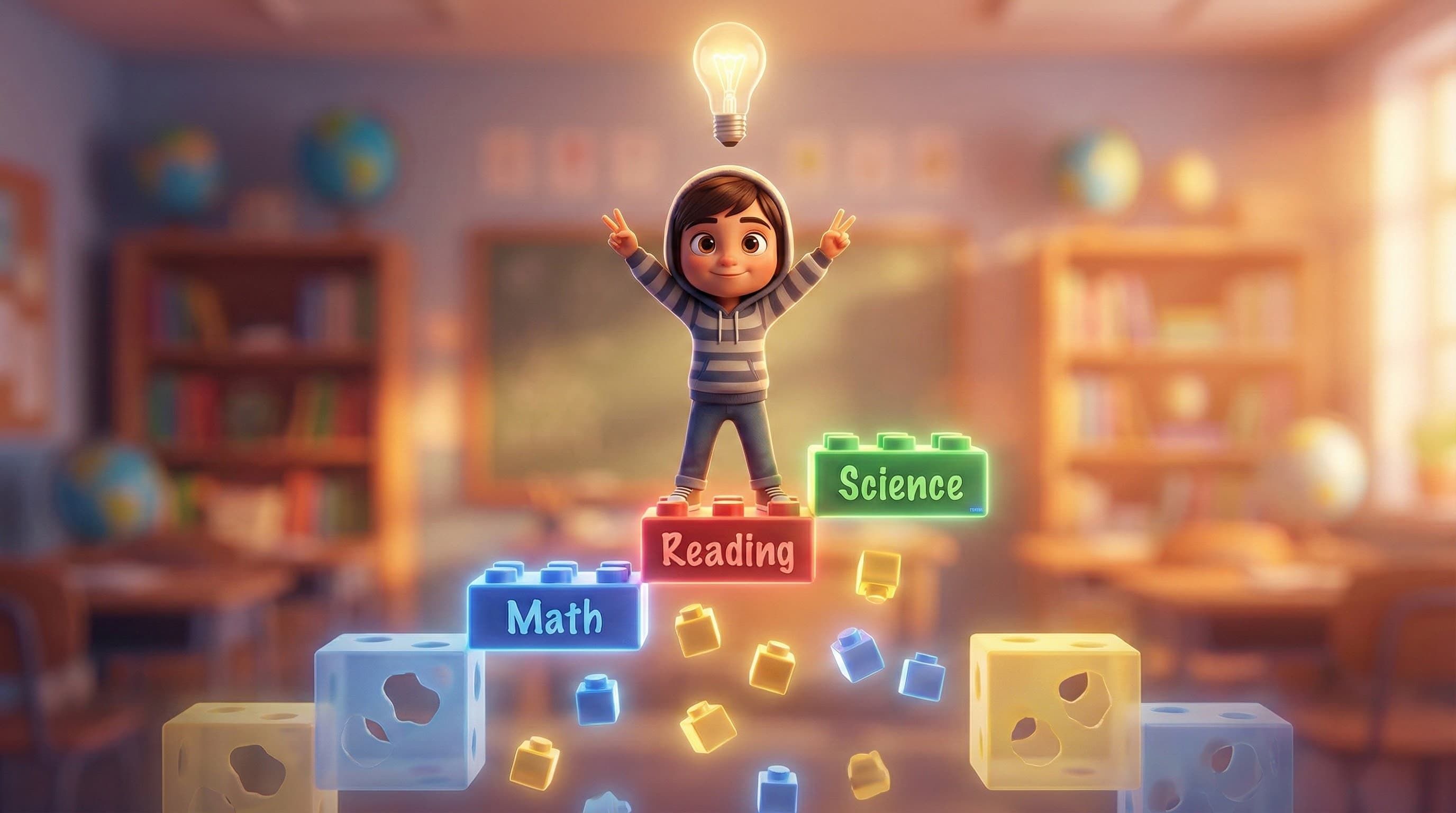
This creates what educators call the "Swiss Cheese" effect. A student might pass 4th-grade math with a C or a B, but they are missing foundational blocks. When they get to complex subjects in grades 3-8, those missing blocks cause the structure to collapse.
A common mistake to avoid is thinking your child just "isn't a math person" or "isn't a science person."
Research highlights that when students struggle with advanced subjects like chemistry, the root cause is often a lack of fluency in basic fractions or division from elementary school (Lonsdale, 2024). The student has the potential to learn chemistry, but they are trying to build a roof on a shaky foundation.
Key takeaway: If your child is struggling in middle school, it is likely not a lack of intelligence. It is a lack of mastery in earlier prerequisites.
What Are the Core Benefits of Mastery-Based Learning?
Mastery-based learning flips the script. Instead of "you have three weeks to learn this chapter," the rule becomes "you have as much time as you need to learn this chapter, but you cannot move on until you score 90% or higher."
The most important benefits include:
-
Closing the Gaps: It forces students to fill those "Swiss cheese" holes. If a 7th grader is stuck on algebra, a mastery system might send them back to practice 4th-grade multiplication tables until they are fluent.
-
Confidence Building: When a student truly masters a topic, they know they know it. This eliminates the anxiety of "guessing" during tests.
-
Higher Ceilings: Studies suggest that with mastery learning and 1-on-1 tutoring, the average student can perform in the top 2% of the traditional class distribution (Bloom, 1984).
Feature
Time-Based System (Traditional)
Mastery-Based System (PrepCraft)
Progression
Moves when calendar says so
Moves when the student proves knowledge
Passing Score
Usually 60 - 70% (D or C)
Usually 90 - 95% (True Proficiency)
Gaps
Ignored and compounded over time
Identified and filled immediately
Focus
Covering the cirriculum
Understanding the material
Essentially, mastery learning changes education from a race against time into a ladder of achievement. You don't skip rungs.
Get instant AI explanations for every benefit of mastery-based learning questions. Start free trial →
How Does AI Act as a "Light Microscope" for Education?
For decades, we knew mastery learning worked, but it was impossible to implement in a classroom of 30 kids. A single teacher cannot track the individual "holes" in 30 different students' knowledge graphs.
Enter Artificial Intelligence.
To put it simply, AI is to education what the light microscope was to medicine. Before the microscope, doctors couldn't see germs. Before AI, teachers couldn't see the granular data of exactly why a student missed a question (Lonsdale, 2024).
AI-driven platforms like PrepCraft act as a personal tutor for your child. They can:
-
Diagnose exactly which specific concept is missing (e.g., "It's not that you don't know algebra; you don't know negative numbers").
-
Adapt the difficulty in real-time to keep the student in the "zone of proximal development" (not too hard, not too easy).
-
Provide Instant Feedback, which is critical for active recall and memory retention.
This is where targeted practice makes the difference. PrepCraft's adaptive algorithms help third and eighth graders experience the actual test format, while AI-powered explanations ensure they understand every mistake - not just memorize answers.
Why Is Mastery Learning More Efficient Than Traditional Schooling?
One of the most surprising benefits of mastery-based learning is how much time it saves.
In a traditional classroom, a lot of time is lost to administrative tasks, transitions, and teaching to the "middle." Advanced students are bored; struggling students are lost.
Data from innovative schools like Alpha School suggests that students can learn up to 10x faster when using adaptive, mastery-based software. They can often cover a full day's worth of academic learning in just 2 hours (Lonsdale, 2024).
The main difference is intensity and personalization.
-
Traditional: 6 hours/day, passive listening, 5% retention.
-
Mastery: 2 hours/day (or 20 mins/day for test prep), active problem solving, 90% retention.
For parents, this means you don't need to hire expensive tutors for hours of drilling. A focused 15-20 minute session of high-quality, AI-driven practice can be more effective than an hour of passive homework.
How Can Parents Support Mastery Without Being the "Nag"?
The hardest part of parenting a student is often the dynamic of "enforcing" homework. It creates friction.
The best approach is a dynamic known as "High Standards, High Support."
-
High Standards: We expect you to master this. We don't accept "I'm just bad at math."
-
High Support: We will give you the tools and love to get there.
In a mastery-based system using AI tools, the platform becomes the "bad guy" when it comes to standards. The app tells the student, "You haven't mastered this yet, try again." This frees you, the parent, to be the cheerleader. You are no longer grading their work; you are helping them interpret the feedback.
Step 1: Set the routine (e.g., 15 minutes before dinner).
Step 2: Let the AI provide the feedback and corrections.
Step 3: Celebrate the "green lights" or mastery badges together.
Access 500+ practice questions with step-by-step solutions →
How Do I Start Mastery-Based Learning at Home?
You don't need to enroll in a Silicon Valley micro-school to access the benefits of mastery-based learning. You can integrate it into your daily routine right now.
First, stop focusing on the grade (A, B, C) and start focusing on the gaps.
Next, use a diagnostic tool. PrepCraft offers adaptive testing for CogAT and Iowa Assessments that identifies exactly where your child stands compared to national norms.
Finally, implement the "15-Minute Rule."
Instead of marathon study sessions, have your child do 15 minutes of intense, active practice daily. The goal isn't just to finish the set; it's to understand why they got an answer wrong.
Bottom line: Mastery is a decision, not a talent. By deciding to close the gaps, any student can perform at the top level.
Frequently Asked Questions
1. Is mastery-based learning too hard for students who are already struggling?
No, it is actually easier emotionally because it meets the child exactly where they are. If a child is struggling with 6th-grade math because of a 4th-grade gap, mastery learning lets them fix the 4th-grade gap first. This builds immediate confidence rather than constant frustration.
2. How long does it take to see results from mastery learning?
Most parents see a change in confidence within 2-3 weeks. Because the system targets the student's specific weaknesses, academic performance often improves significantly within 4-8 weeks of consistent practice (Lonsdale, 2024).
3. Does this work for standardized tests like CogAT or Iowa Assessments?
Yes, perfectly. Standardized tests measure reasoning and foundational knowledge. Mastery learning ensures those foundations are solid, preventing the "careless errors" that often lower scores for bright students.
4. What if my child gets bored repeating the same topic?
True mastery systems use AI to vary the questions and approach. If a student is stuck, the system doesn't just repeat the question; it offers a new way to look at the problem or breaks it down into smaller steps.
5. Can I use mastery learning alongside regular school?
Absolutely. Think of it as a supplement. While school moves at the class's pace, your 15-minute home mastery sessions ensure your child isn't developing any "Swiss cheese" holes along the way.
Conclusion
The benefits of mastery-based learning go beyond just better test scores. They give your child the gift of confidence. By moving away from the "Swiss cheese" model of education and ensuring every brick in their knowledge foundation is solid, you are setting them up for a lifetime of academic success.
You don't need hours of tutoring. You just need the right tool and 15 minutes a day.
Start your free PrepCraft trial today and help your child master grades 3-8 test prep → PrepCraft