Your 'Lazy' Kid Isn't Lazy—They're Terrified
TL;DR
Helping child overcome test anxiety often requires addressing the emotional "armor" children wear - behaviors like avoidance, rebellion, or feigned indifference - to protect themselves from the vulnerability of failure. According to psychological research, the most effective approach isn't cramming, but building self-trust slowly through consistent, low-stakes practice. By using "high standards with high support," parents can transform test preparation from a fearful judgment into a confidence-building routine. For grades 3-8, this means engaging in 15-20 minutes of daily practice to fill their "marble jar" of confidence well before test day.
Why Your Child’s "Laziness" Is Actually Armor: A New Approach to Overcoming Test Anxiety
Table of Contents
"I don't care about this test. It's stupid." If you are a parent of a student in grades 3-8, you have likely heard this phrase. It usually happens right when you suggest sitting down to study. It looks like rebellion. It looks like laziness. But if we dig a little deeper, we find that overcoming test anxiety in children isn't about fixing an attitude problem. It is about safety.
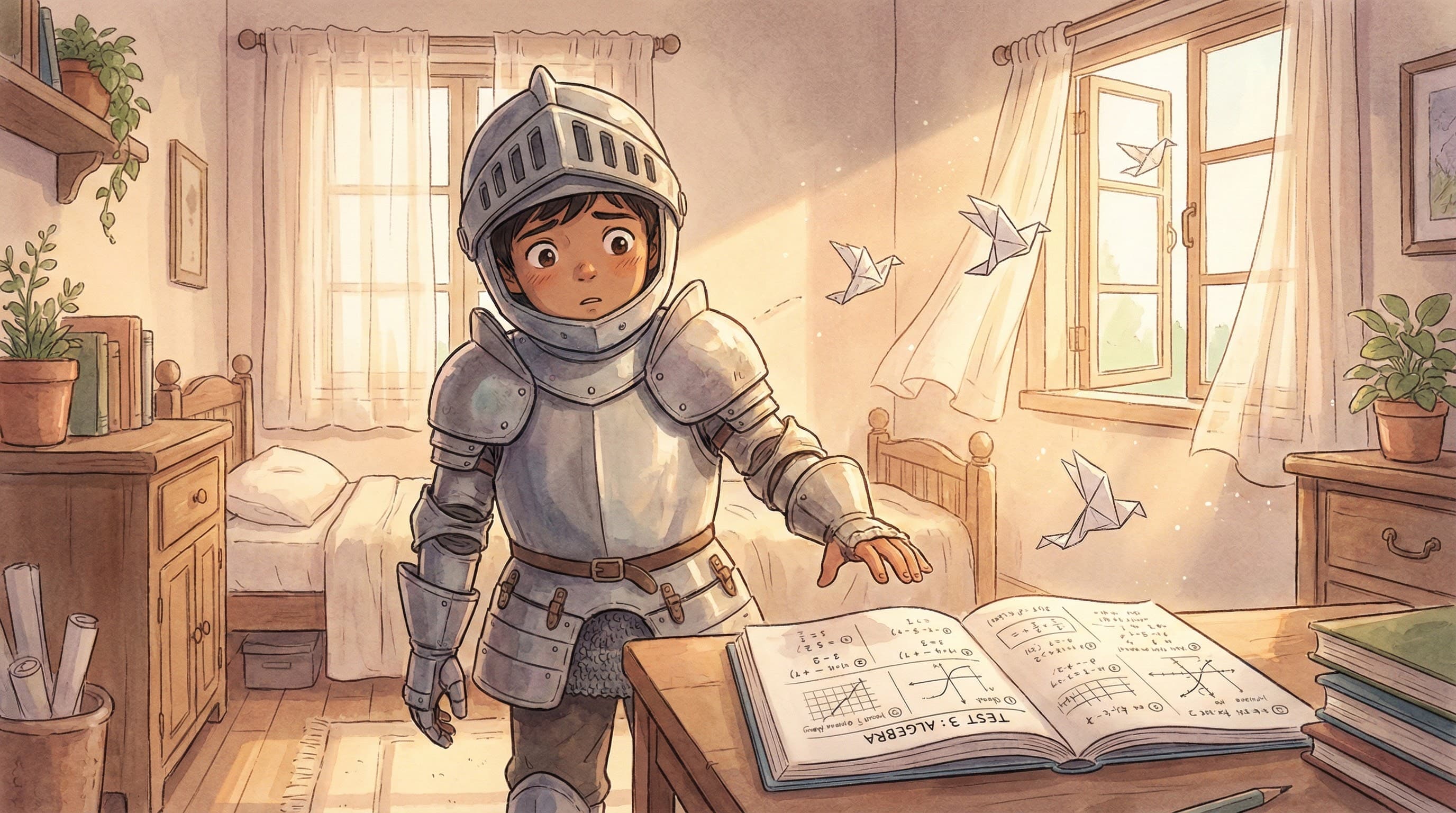
In simple terms, what you are seeing is not a lack of motivation. It is what researcher Brené Brown calls "armor" (Brown, 2024). When a child feels vulnerable - and taking a standardized test is a deeply vulnerable act where they are being measured and judged - they instinctively self-protect. They "armor up." If they don't study and fail, they can say, "Well, I didn't try." But if they try their hardest and fail? That hurts. That confirms their worst fear: that they aren't smart enough. This guide will help you dismantle that armor, not through force, but by building genuine confidence.
Try PrepCraft's grades 3-8 practice test free for 7 days → PrepCraft
What Is the Real Root of Test Anxiety?
The real root of test anxiety in grades 3-8 students is often a fear of vulnerability rather than a lack of academic ability. When children refuse to study or act out before a test, they are using emotional "armor" to protect their self-esteem from the potential pain of trying their best and still failing. We often think anxiety looks like shaking hands or a stomach ache. While those are physical symptoms, the emotional root is often disguised as perfectionism, procrastination, or indifference. The definition of armor in this context is the thoughts, emotions, and behaviors your child uses to avoid the feeling of being exposed or "less than" (Brown, 2024).
The Myth of Vulnerability
We are often taught that vulnerability is weakness. But as Brown notes, "There is no courage without vulnerability" (Brown, 2024). Taking a test requires courage. It requires a child to say, "I am going to show you what I know, and I risk you telling me it isn't enough." When we push our kids to "just study hard" without acknowledging this fear, we are asking them to go into battle without addressing why they are terrified. Key takeaway: If your child is acting out, stop looking at the behavior and look for the fear. They aren't fighting you; they are fighting the feeling of being exposed.
How Can the "Marble Jar" Method Build Confidence?
The "Marble Jar" method builds confidence by treating trust in oneself as something earned in small, consistent moments rather than one big event. Just as you fill a jar one marble at a time, students build academic self-trust through short, daily practice sessions rather than stressful cramming marathons. Brené Brown describes trust as a "marble jar" (Brown, 2024). You cannot fill a jar by smashing a boulder into it - that breaks the jar. In test prep, "cramming" is the boulder. It is a "smash and grab" attempt at confidence. It rarely works, and it usually leaves the child feeling more anxious.

Building Trust "Marble by Marble"
To help your child with overcoming test anxiety in children, you need to shift the focus from the big test day to the small daily wins.
The most effective preparation includes:
-
Step 1: Establish a routine of just 15-20 minutes of practice a day.
-
Step 2: Frame each session as adding a "marble" to their jar of confidence.
-
Step 3: Celebrate the effort of showing up, not just the score.
This is where targeted practice becomes vital. When a child logs into PrepCraft and answers five questions correctly, they add a marble. When they get a question wrong but read the explanation and understand why, they add two marbles. A common mistake to avoid is treating the practice test as a "litmus test" for their intelligence. Do not throw a full-length, difficult exam at them on day one. That is a "smash and grab" that destroys trust. Build up to it slowly.
Get instant AI explanations for every overcoming test anxiety in children question. Start free trial → PrepCraft
Why Is Shame the Enemy of Learning?
Shame is the enemy of learning because it convinces children that being confused means they are "stupid," causing them to disengage to protect their self-worth. When a student feels shame about not knowing an answer, they stop asking questions, which halts the learning process entirely. In a classroom or even with a parent, asking a "basic" question can feel risky. A child might think, "If I ask this, everyone will know I don't get it." This is where armor comes back up. They stay silent, nod along, and the gap in their knowledge grows.
The Role of AI in Removing Shame
This is a hidden benefit of using an AI tutor for test prep. A bot does not judge. It does not sigh when you ask the same question three times. It does not have a disappointed look. In simple terms, PrepCraft’s AI, PrepPal, creates a "shame-free zone." When a student gets a question wrong on a CogAT practice test, the AI simply explains the logic. It neutralizes the failure. It turns "I'm stupid" into "Oh, I missed that pattern." This allows the child to be vulnerable enough to learn without the threat of social judgment. According to educational psychologists, "Reducing the fear of negative evaluation is critical for cognitive performance" (Putwain, 2023). By removing the human judgment factor during practice, we lower the stakes and lower the anxiety.
How Do I Help My Child Drop the Armor?
You can help your child drop the armor by shifting your language from high-pressure expectations to high-support collaboration. Instead of demanding results, validate their feelings of fear and provide concrete tools that make the task feel manageable.
Bottom line: You cannot rip the armor off your child. They have to choose to take it off because they feel safe.
Strategies for De-Armoring
Here is how to apply this to your daily routine:
-
Name the Armor: When your child acts out, say, "I can see you're frustrated. Sometimes when I'm scared of failing, I act grumpy too. Is that what's happening?"
-
Separate Worth from Scores: Remind them that understanding CogAT and Iowa tests is about measuring a specific set of skills at a specific moment, not measuring their value as a human.
-
Focus on Mastery, Not Performance: Praise the process. "I love how you figured out that matrix puzzle," not "Good job getting an A."
The most important thing is to model vulnerability yourself. Share a time you were scared to be tested or judged. Show them that you survived it.
Comparison: High Standards vs. High Support
Approach | What it Looks Like | Child's Reaction (The Armor) |
|---|---|---|
High Standards / Low Support | "You need to get into the gifted program. Go study." | Rebellion, refusal, "I don't care." |
Low Standards / High Support | "It's okay, the test doesn't matter, don't worry." | Anxiety remains, lack of preparation, feeling incapable. |
High Standards / High Support | "This test is hard, and I know you can do it. Let's practice for 15 mins together." | De-armoring, trust, willingness to try. |
In summary: High support means providing the right tools - like structured Iowa Assessments practice - and the emotional safety to use them without fear.
Access 2500+ practice questions with step-by-step solutions → PrepCraft
FAQ
What are the physical signs of test anxiety in children?
Physical signs often include headaches, stomach aches, nausea, rapid heartbeat, or sweating before a study session or test. However, emotional signs like irritability, anger, "clowning around," or absolute refusal to engage are just as common in grades 3-8.
How much should my child practice to reduce anxiety?
Consistency beats intensity. We recommend 15-20 minutes a day, 4-5 days a week. This "marble jar" approach builds familiarity with the test format without causing burnout, which is the primary driver of anxiety.
Can test anxiety be cured completely?
Anxiety is a natural human emotion, so it may not disappear completely. The goal of overcoming test anxiety in children is not to eliminate fear, but to manage it so it doesn't paralyze them. We want to turn "panic" into "focused excitement."
How does PrepCraft help with test anxiety specifically?
PrepCraft helps by simulating the test environment in a low-stakes way. By exposing students to the exact question types (like CogAT paper folding or Iowa vocabulary) repeatedly, the "unknown" becomes "known." Familiarity destroys fear.
Is it better to study alone or with a parent?
For anxious children, studying with a supportive parent (or "co-regulating") is often better initially. Sit with them. As they build confidence (marbles), you can gradually step back and let them practice independently with the AI tutor.
## Conclusion

**Overcoming test anxiety in children** is not about forcing your child to be tougher. It is about creating a space where they feel safe enough to be vulnerable. It is about recognizing that their "laziness" is armor, and that their confidence must be built slowly, one marble at a time. By combining high standards with high support - and using tools that encourage mastery rather than shame - you can turn test prep from a battleground into a bonding experience.

Start your free PrepCraft trial today and help your child master grades 3-8 test prep → [PrepCraft]([https://www.prepcraft.ai](https://www.prepcraft.ai))

## References

Brown, B. (2024). _The Algorithms Have Forced Us Into A Hidden Epidemic_. Available at: [https://diaryofaceo.com/](https://diaryofaceo.com/) (Accessed: December 4, 2025).

Putwain, D.W. (2023). 'Test anxiety and academic performance: A review of the literature', _Educational Psychology Review_, 35(1), pp. 1-24.