Why Your "Average" Student Is Actually Genius: The Secret to Identifying multiple intelligences in children

TL;DR
**Identifying multiple intelligences in children** is the process of recognizing that kids learn through eight distinct modalities (like musical, spatial, or interpersonal) rather than just the two measured by schools (logical and linguistic). According to Dr. Howard Gardner, schools should function more like "children's museums" where kids explore natural curiosities (Gardner, 2025). However, because standardized tests act as gatekeepers, parents must find a balance. The most effective strategy is to use efficient, targeted preparation to master the "boring" academic requirements quickly - spending 15-20 minutes daily on focused practice - to free up the remaining hours for your child's true passions.
In simple terms, identifying multiple intelligences in children is about realizing that an IQ score is a very narrow slice of who your child actually is. You know the scene. It is 7:00 PM on a Tuesday. Your third grader is crying over a math worksheet. They feel stupid. You feel helpless. Yet, this same child spent three hours on Saturday building a complex architectural structure out of recycled cardboard or composing a song on the piano without reading a single note. The problem isn't your child. The problem is that traditional schooling - and the standardized tests that come with it - usually only measures two things: how well you use words and how well you use logic. But as Dr. Howard Gardner, the Harvard psychologist who revolutionized education, explains, there is a better way to view your child's potential (Gardner, 2025). This guide will help you navigate identifying multiple intelligences in children in grades 3-8, and more importantly, show you how to hack the school system so your child can ace their tests without losing their soul.
Try PrepCraft's grades 3-8 practice test free for 7 days → PrepCraft
What Is the Theory of Multiple Intelligences?
The definition of Multiple Intelligences (MI) theory is the idea that human intelligence is not a single, fixed number like an IQ score. Instead, it is a set of relatively independent computers in the mind. Dr. Gardner argues that while schools focus on Linguistic and Logical-Mathematical intelligence, there are actually several others, including Musical, Spatial, Bodily-Kinesthetic, Interpersonal (people smart), Intrapersonal (self-smart), and Naturalist intelligence (Gardner, 2025). If you judge a fish by its ability to climb a tree, it will live its whole life believing it is stupid. When we focus strictly on identifying multiple intelligences in children through the lens of a report card, we miss the fish's ability to swim.
Key takeaway: Your child might be "multiply intelligent" in ways that a standard classroom simply lacks the tools to measure.
Why Do Standardized Tests Miss So Much Potential?
Standardized tests like the CogAT or Iowa Assessments are efficient predictors of who will succeed in a traditional school setting. They are not predictors of who will succeed in life. Dr. Gardner notes that if you lived 150 years ago, entrance to Harvard required Latin, Greek, and Hebrew (Gardner, 2025). Nobody cared about your math skills. Today, the metric has shifted, but it is still limited. Tests measure a specific type of processing speed and logical reasoning. A common mistake to avoid is thinking that a low test score means your child lacks intelligence. It often just means their primary intelligence isn't being asked for on the exam. However, we have to be pragmatic. These scores still open doors to gifted programs and better educational resources. This creates a painful friction for parents: do we force our creative, spatial, or musical kids to drill "boring" logic puzzles? This is where understanding the system helps. You can use tools like PrepCraft's CogAT practice to demystify the testing process. By treating the test as a game to be mastered rather than a judgment of worth, you lower the stakes and the anxiety.
How Does the "Children's Museum" Model Change Learning?
Dr. Gardner suggests that the ideal school should function like a children's museum (Gardner, 2025). In a children's museum, nobody flunks. You go in, you explore, and you find what captures your attention. Maybe your child spends an hour at the water table (physics/naturalist) or goes straight to the stage to put on a costume (interpersonal/linguistic). The most effective preparation includes observation. Just as Gardner's parents bought him a piano after seeing him pick out tunes at a neighbor's house - despite them not being musical themselves - your job is to provide the resources for what naturally interests your child. When we force children to spend all their energy on things they are bad at, we rob them of the energy to become excellent at what they are good at.

Get instant AI explanations for every identifying multiple intelligences in children question. Start free trial → PrepCraft
How Can You Hack the System to Buy More Time?
Here is the pivot. We agree that the system is reductive. But until colleges and gifted programs change their admissions criteria, we have to play the game. The goal is to be efficient. You do not want your child spending three hours a night struggling with test prep. That kills the "Children's Museum" time.
The most important strategy is the "Time-Back" approach. Use technology to compress the drudgery.
-
Step 1: Use adaptive AI tools to identify exactly where your child is struggling on the "school" stuff.
-
Step 2: Spend 15-20 minutes a day on targeted practice - no more.
-
Step 3: Use the recovered time for the "museum" activities: sports, art, coding, or just playing outside.
This is where AI tutors for test prep shine. They don't waste time reviewing what your child already knows. They laser-focus on the gap, close it, and get your child back to their life.
Many parents find that reducing test anxiety is just as important as content review. When a child realizes they can master the "boring stuff" quickly, they gain confidence. They realize, "I'm not stupid; I just needed to learn the rules of this specific game."
Which Signs Point to Hidden Genius in Your Child?
In summary, if your child struggles with identifying multiple intelligences in children via standard tests, look for these alternative signs of brilliance:
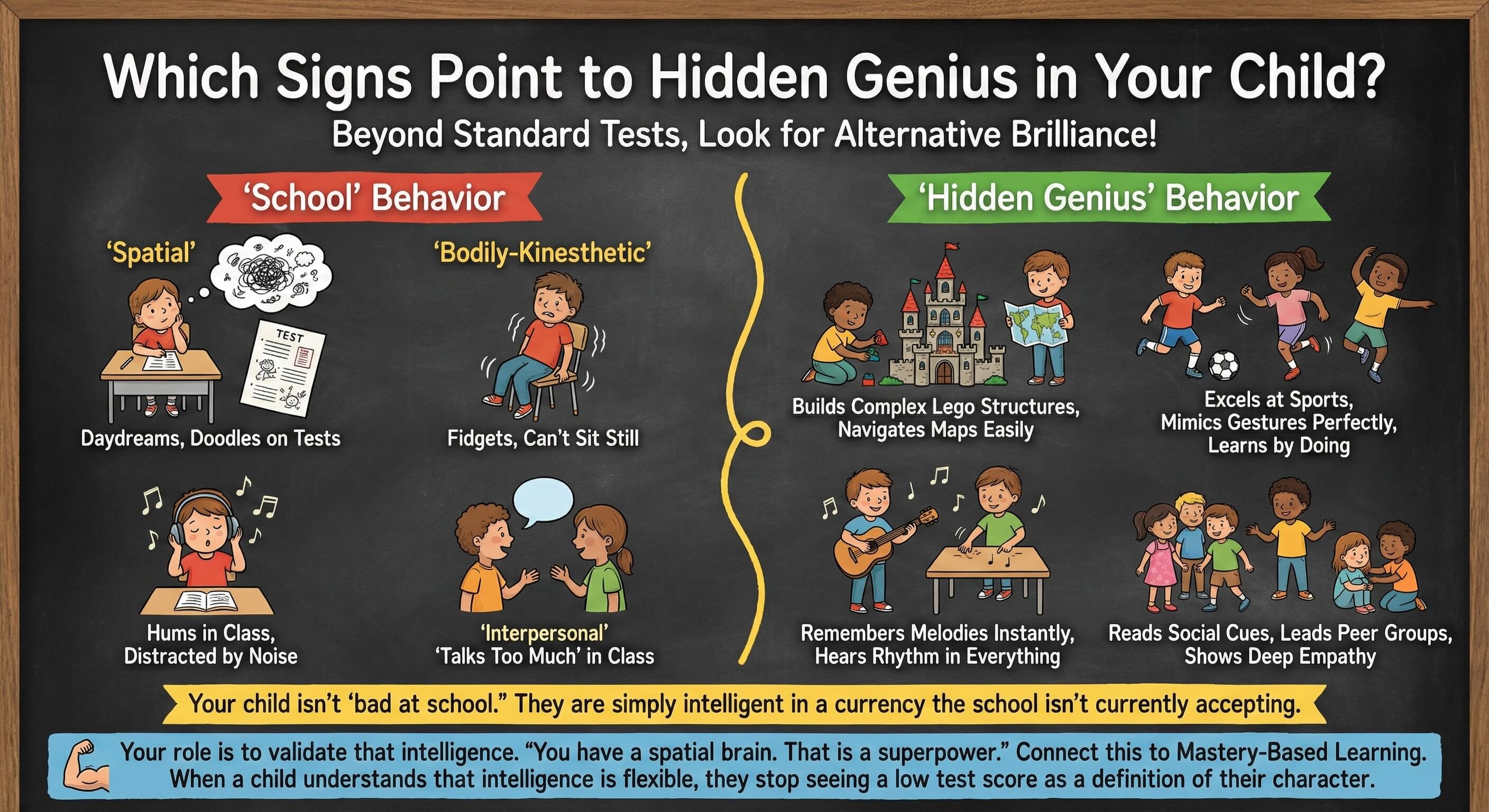
If you see these signs, your child isn't "bad at school." They are simply intelligent in a currency the school isn't currently accepting. Your role is to validate that intelligence. Tell them, "You have a spatial brain. That is a superpower. We just need to practice the 'word' stuff so you can get into the programs that let you use your spatial brain." Connect this to mastery-based learning. When a child understands that intelligence is flexible and can be grown, they stop seeing a low test score as a definition of their character.
How to Start Identifying Multiple Intelligences in Children Today?
Bottom line: Don't wait for the school to tell you who your child is. First, observe them in their "flow" state. What are they doing when they lose track of time? Next, validate that activity as "work." Gardner defines good work as excellent, engaging, and ethical (Gardner, 2025). If they are building a Minecraft server, they are doing engineering and logic work. Finally, use tools like PrepCraft to handle the academic requirements efficiently.
Access 25000+ practice questions with step-by-step solutions → PrepCraft
Frequently Asked Questions
What are the 8 multiple intelligences in children?
The eight intelligences identified by Dr. Howard Gardner are Linguistic, Logical-Mathematical, Spatial, Bodily-Kinesthetic, Musical, Interpersonal, Intrapersonal, and Naturalist. Some lists also include Existential intelligence.
Can a child have more than one intelligence?
Yes! Most children (and adults) have a unique mix of several intelligences. It is rare to be strong in only one. The goal of identifying multiple intelligences in children is to find your child's unique profile of strengths.
Do schools test for multiple intelligences?
Generally, no. Most standard schools and standardized tests (like the CogAT or Iowa Assessments) focus primarily on linguistic and logical-mathematical skills. This is why many "gifted" children in other areas go unrecognized by the school system.
How can I help my child if they don't fit the "school smart" mold?
Focus on "hacking" the test preparation to be as efficient as possible so they don't fall behind, but pour your enthusiasm into their natural strengths. Validate their artistic, athletic, or social skills as "real" intelligence.
Is the CogAT test biased against creative kids?
The CogAT measures reasoning, which is different from creativity. However, highly creative kids often overthink simple questions or see patterns that aren't "correct" by the test's standards. Did your bright child just "fail" the CogAT? Read our guide on why this happens.
About the Author
Dr. Emily Rodriguez, Ph.D. is PrepCraft's Lead Curriculum Developer specializing in cognitive assessment and gifted education for elementary and middle school students. With 15 years of experience in educational psychology, Dr. Rodriguez has developed standardized test preparation programs used by over 100 schools across California and Texas.
Dr. Rodriguez holds a Ph.D. in Educational Psychology from UCLA and is a certified gifted education specialist. She has personally coached more than 3,000 students preparing for CogAT and Iowa Assessments, with 89% of her students achieving scores in the 90th percentile or higher. Her research on test preparation effectiveness has been published in the Journal of Educational Assessment.
Conclusion
Identifying multiple intelligences in children isn't just about labeling your child; it's about liberating them. It allows you to say, "You are smart, even if the test didn't show it today."
By adopting the "Children's Museum" mindset, you encourage exploration and curiosity. And by using efficient tools to master the necessary standardized tests, you buy your child the time they need to become the musician, artist, or leader they were meant to be.
Start your free PrepCraft trial today and help your child master grades 3-8 test prep → PrepCraft
References
Gardner, H. (2025). Howard Gardner: Rethinking College in the Age of AI. Available at: [Transcript Source] (Accessed: January 21, 2026).