The Hidden Reason Your Grade 3 Child Struggles With OLSAT 8 test guide for parents

TL;DR
The OLSAT 8 (Level D) for grade 3 is a standardized assessment used to identify gifted students by measuring verbal, nonverbal, and quantitative reasoning. Unlike earlier levels, grade 3 is the "Reading Cliff" where students must read questions themselves rather than listening to a teacher. The test takes 60-75 minutes and yields a School Ability Index (SAI) score. To prepare effectively, focus on building reading stamina, logic puzzles, and spatial reasoning games over 4-8 weeks. Avoid cramming and prioritize understanding the logic behind every answer using adaptive practice tools.
Table of Contents
In simple terms, the OLSAT 8 test guide for parents is your roadmap to understanding one of the most common "gatekeepers" for gifted and talented programs in the United States. If you are a parent of a third grader, you might be feeling the pressure. You know your child is bright. You see their curiosity and their ability to solve problems. But now there is a standardized test standing between them and the advanced educational resources they deserve.
This guide is designed to demystify the process. We aren't just talking about rote memorization here. We are talking about understanding how your child thinks. Whether you are aiming for a specific magnet school or just want to understand your child's cognitive profile, this OLSAT 8 test guide for parents will walk you through everything you need to know for grade 3 success.
Try PrepCraft's grade 3 practice test free for 7 days → PrepCraft
What Is the OLSAT 8 Test?
The OLSAT 8 (Otis-Lennon School Ability Test, Eighth Edition) is not an IQ test in the traditional sense. It is an assessment of "school ability." This means it measures the specific cognitive skills that predict how well a student will perform in an academic environment (Pearson, 2026).
Essentially, while achievement tests measure what your child has already learned (like history facts or math formulas), the OLSAT 8 measures your child's potential to learn new information (Cogn-IQ, 2026). This predictive quality is why schools use it to identify candidates for Gifted and Talented Education (GATE) programs.
The test operates on the premise that intelligence isn't just one thing. It breaks down cognitive ability into specific clusters. A student might be a genius at visual puzzles (figural reasoning) but struggle with word relationships (verbal reasoning). The OLSAT 8 identifies these specific strengths and weaknesses (Pearson, 2026).
Key takeaway: The OLSAT 8 looks forward at potential, not backward at what was taught in class.
Why Is the Grade 3 OLSAT (Level D) So Difficult?
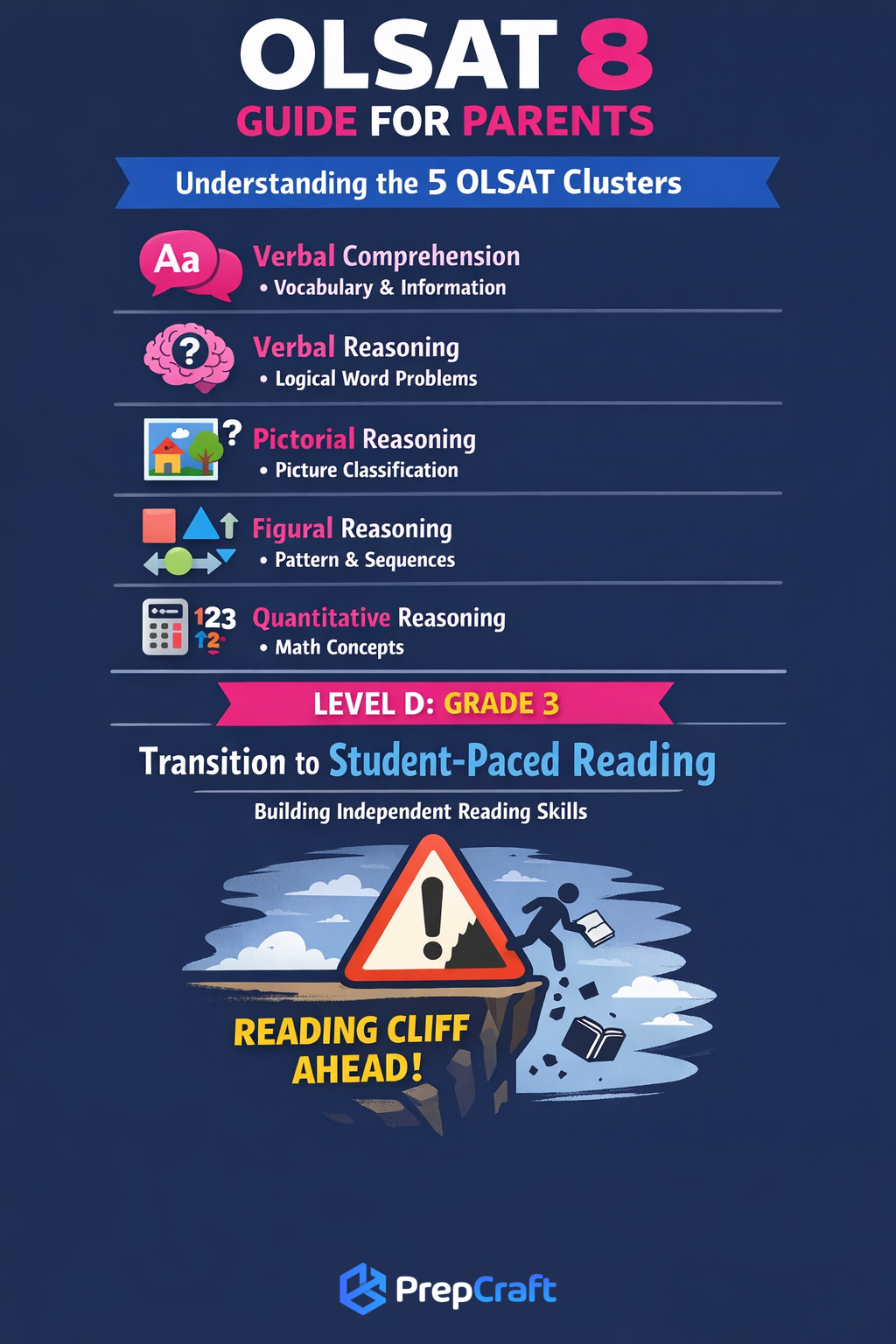
For third graders, the OLSAT 8 (Level D) represents a massive shift in testing format. In grades K-2, the teacher reads the questions aloud to the students. But starting in Grade 3 (Level D), the test becomes self-paced for the verbal sections (TestPrep-Online, 2026).
The main difference is what experts call the "Reading Cliff." Your child must now read the questions, process the logic, and select the answer entirely on their own.
This means a student with high reasoning ability but average reading speed might struggle. They might run out of time not because they couldn't solve the puzzle, but because they couldn't read the instructions fast enough. This is why many parents notice a dip in scores between 2nd and 3rd grade.
A common mistake to avoid is assuming your child understands the format. The Level D test removes pictorial reasoning (simple picture games) and replaces them with more complex verbal analogies and quantitative reasoning tasks (TestPrep-Online, 2026).
What Questions Are on the OLSAT 8?
The OLSAT 8 Level D consists of 64 questions split between Verbal and Nonverbal sections. These are further broken down into five specific clusters. Understanding these clusters is vital for targeted preparation.
1. Verbal Comprehension and Reasoning
These questions test how well a student understands the structure of language and the logic hidden within words.
-
Antonyms: Students must identify words with opposite meanings. This requires more than just vocabulary; it requires precise definitions (TestPrep-Online, 2026).
-
Sentence Completion: A logic puzzle disguised as a reading task. Students choose a word that logically completes a sentence based on context clues.
-
Verbal Analogies: The classic "A is to B as C is to D" format. Example: "Finger is to Hand as Toe is to...?" (Foot). This tests relational thinking (Testing Mom, 2026).
2. Nonverbal and Figural Reasoning
This represents "fluid intelligence" - the ability to solve novel problems using abstract shapes. It minimizes the impact of language barriers.
-
Pattern Matrix: Students view a grid (2x2 or 3x3) with a missing piece and must use rules from rows and columns to find the missing element. This is often considered the gold standard of nonverbal testing (Gifted Ready, 2026).
-
Figural Series: Predicting the next step in a geometric progression, such as a shape rotating clockwise.
3. Quantitative Reasoning
These questions focus on number patterns rather than word problems.
-
Number Series: Identifying the rule in a sequence like "2, 4, 8, 16..." (Doubling).
-
Numeric Inference: Deducing relationships between sets of numbers to solve a puzzle (Testing Mom, 2026).
Get instant AI explanations for every OLSAT 8 test guide for parents question. Start free trial → PrepCraft
How Are OLSAT Scores Calculated?
In simple terms, the OLSAT doesn't give a percentage grade like a math test. It compares your child to other students across the nation.
The School Ability Index (SAI)
The SAI is a normalized standard score.
-
Average Score: 100
-
Gifted Cutoff: Typically 132 (Top 2% of the population)
-
Range: 50 to 150 (Assessment Resource Center, 2026)
Age vs. Grade Percentiles
The OLSAT provides two rankings:
-
Age Percentile Rank (APR): Compares your child to others exactly their age (in 3-month bands).
-
Grade Percentile Rank (GPR): Compares your child to all other 3rd graders.
Key takeaway: Most gifted programs prioritize the APR. This ensures that a "young" 3rd grader born in August isn't penalized when compared to an "old" 3rd grader born the previous September (Gifted Ready, 2026).
How Should I Prepare My Child for the OLSAT?
Bottom line: Start practice 4-8 weeks before the test with short, focused sessions. Do not cram.
This is where targeted practice makes the difference. PrepCraft's simulations help third graders experience the actual test format, while AI-powered explanations ensure they understand every mistake - not just memorize answers.
The most effective preparation includes:
Step 1: Diagnostic Assessment
Take a full-length practice test to identify if your child struggles more with verbal logic or spatial patterns. This prevents wasting time on skills they have already mastered.
Step 2: Build "Listening" and Reading Stamina
Even though Level D is student-read, focus is key. Practice reading multi-step instructions without rushing. Have your child read a short paragraph and explain the main idea back to you to check comprehension (Funderstanding, 2026).
Step 3: Tangrams and Spatial Play
For the nonverbal sections, physical manipulatives help. Playing with tangrams or block designs helps children understand rotation and symmetry, which are critical for Figural Classification questions (Whiz Kidz, 2026).
Step 4: Consistent Micro-Practice
Instead of 2-hour marathons, do 15-20 minutes daily. This builds the neural pathways for logic without causing burnout. Many parents find that reducing test anxiety is just as important as content review.
The most important factor is consistency. A child who practices a little every day will outperform a child who crams the weekend before.
Common Preparation Mistakes to Avoid
A common mistake to avoid is focusing only on the raw score. Parents often panic if a child gets 55/60. However, depending on the test difficulty, that could still be the 99th percentile (TestPrep-Online, 2026).
Don't make the error of ignoring the "I Don't Know" strategy. Teach your child that it is okay to guess if they are stuck. Leaving an answer blank is a guaranteed zero, but a guess is a chance. The OLSAT 8 has no penalty for wrong answers (YouTube, 2026).
Finally, avoid silence on the topic of anxiety. Your child knows this test is important. Talk about it. Test anxiety strategies can be the difference between a good score and a great one.
Access 25000+ practice questions with step-by-step solutions → PrepCraft
Frequently Asked Questions
Is preparing for the OLSAT considered cheating?
No. In simple terms, preparation is about familiarizing your child with the format so their score reflects their true ability, not their confusion about the instructions. "Cramming" answers is ineffective, but learning the logic behind the questions is standard educational practice (TestPrep-Online, 2026).
What is a good score on the OLSAT 8?
Most gifted programs look for an SAI of 132 or higher, which is roughly the top 2% of students. However, some districts accept scores in the 95th percentile or use a matrix that combines OLSAT scores with grades and teacher recommendations (Gifted Ready, 2026).
Can my child use scratch paper during the test?
For Grade 3 (Level D), policies vary by district. While scratch paper is often allowed for math sections in upper grades, you must verify this with your specific school. If scratch paper isn't allowed, your child needs to practice doing mental math calculations (Pearson, 2026).
Why is there a difference between my child's Verbal and Nonverbal scores?
A significant split can be diagnostic. High Verbal/Low Nonverbal might suggest a student who relies on language but struggles with spatial processing. Low Verbal/High Nonverbal is common in gifted students with dyslexia or English Language Learners (ELLs), where the Nonverbal score is often the better indicator of true potential (Pearson, 2026).
How long does the OLSAT Grade 3 test take?
The test typically requires 60 to 75 minutes of actual working time, plus administrative time for instructions. It is usually administered in one sitting (Pearson, 2026).
Conclusion
The OLSAT 8 is a rigorous test, but it doesn't have to be a nightmare. By understanding the "Reading Cliff" of Level D and focusing on the underlying logic of the questions, you can help your third grader approach test day with confidence.
Remember, this test is just one snapshot of your child's ability. Whether they qualify for a specific program or not, the critical thinking skills they build during preparation - like mastery based learning - will serve them for a lifetime.
Start your free PrepCraft trial today and help your child master grade 3 test prep → PrepCraft
References
Assessment Resource Center (2026). OLSAT 8 (Otis-Lennon School Ability Test, Eighth Edition). Available at: https://arc.missouri.edu/olsat8/ (Accessed: January 25, 2026).
Cogn-IQ (2026). Otis-Lennon School Ability Test (OLSAT): Complete Guide. Available at: https://www.cogn-iq.org/learn/tests/olsat/ (Accessed: January 25, 2026).
Funderstanding (2026). Simple Yet Powerful Home Activities for Aural Learning. Available at: https://funderstanding.com/parents/simple-yet-powerful-home-activities-for-aural-learning/ (Accessed: January 25, 2026).
Gifted Ready (2026). OLSAT Test Scores Explained: Gifted Cutoffs & Percentiles (2026). Available at: https://www.giftedready.com/olsat/test-scores/ (Accessed: January 25, 2026).
Pearson (2026). OLSAT 8 - Otis-Lennon School Ability Test | Eighth Edition. Available at: https://www.pearsonassessments.com/en-us/Store/Professional-Assessments/Academic-Learning/Otis-Lennon-School-Ability-Test-%7C-Eighth-Edition/p/100000003 (Accessed: January 25, 2026).
Testing Mom (2026). OLSAT (Otis-Lennon School Ability Test®). Available at: https://www.testingmom.com/tests/olsat-test-5/ (Accessed: January 25, 2026).
TestPrep-Online (2026). What is The OLSAT Test? Learn About The OLSAT 8. Available at: https://www.testprep-online.com/what-is-olsat (Accessed: January 25, 2026).
Whiz Kidz (2026). Encouraging Spatial Reasoning with Tangram Activities. Available at: https://www.whizkidz.com.au/encouraging-spatial-reasoning-with-tangram-activities/ (Accessed: January 25, 2026).
YouTube (2026). OLSAT Test Overview. Available at: https://www.youtube.com/watch?v=YVF__K_3XfY (Accessed: January 25, 2026).